RailBook™ autonomously detects problems and state changes across your systems — then responds and remediates them deterministically. Every action runs exactly as designed, and every result is verified. From data-center servers to edge-AI and robotics SoMs.
Your own — state your intent, and the Co-Author writes RailBooks for your own systems
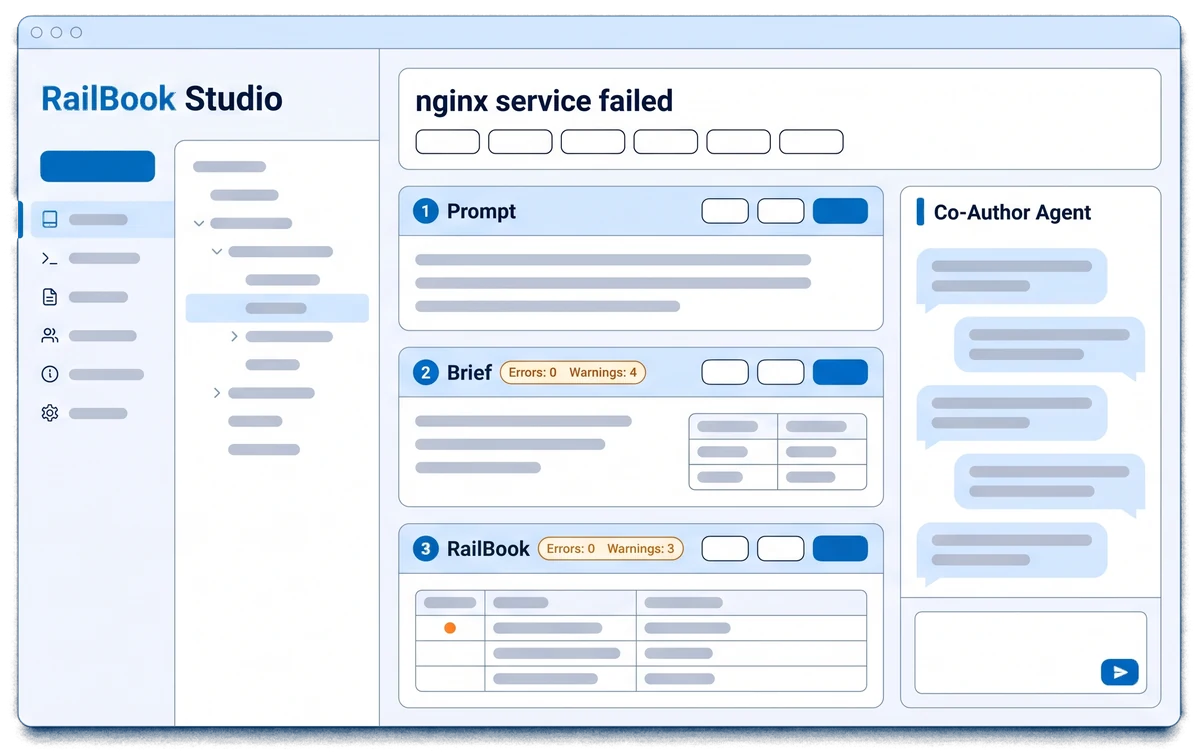
Prompt
A Detect and Remediate RailBook for Ubuntu Server 24.04 where nginx.service (systemd) has entered the failed state — detected via the journal entry "nginx.service: Failed with result" — that restarts the unit, validates it is active and nginx is listening on port 443, and escalates to a person if the restart fails.
Server operations on Linux Server. A failed nginx web server service — detected, restarted and verified. Simplified illustration of RailBook Studio.
Every system changes and fails. Today's answers don't scale.
People
Slow, expensive, and not there at 3 a.m., on the plant floor, or beside a device in the field.
Scripts
Handle only the case someone thought of, break on the first variation, and are never finished.
Improvising AI agents
Decide at run time, so the same event gets different answers. Hard to audit, and usually dependent on the cloud.
RailBook is the autonomous agent that stays on its rails.
The Agentic RailBook
An agent's intelligence. A program's certainty.
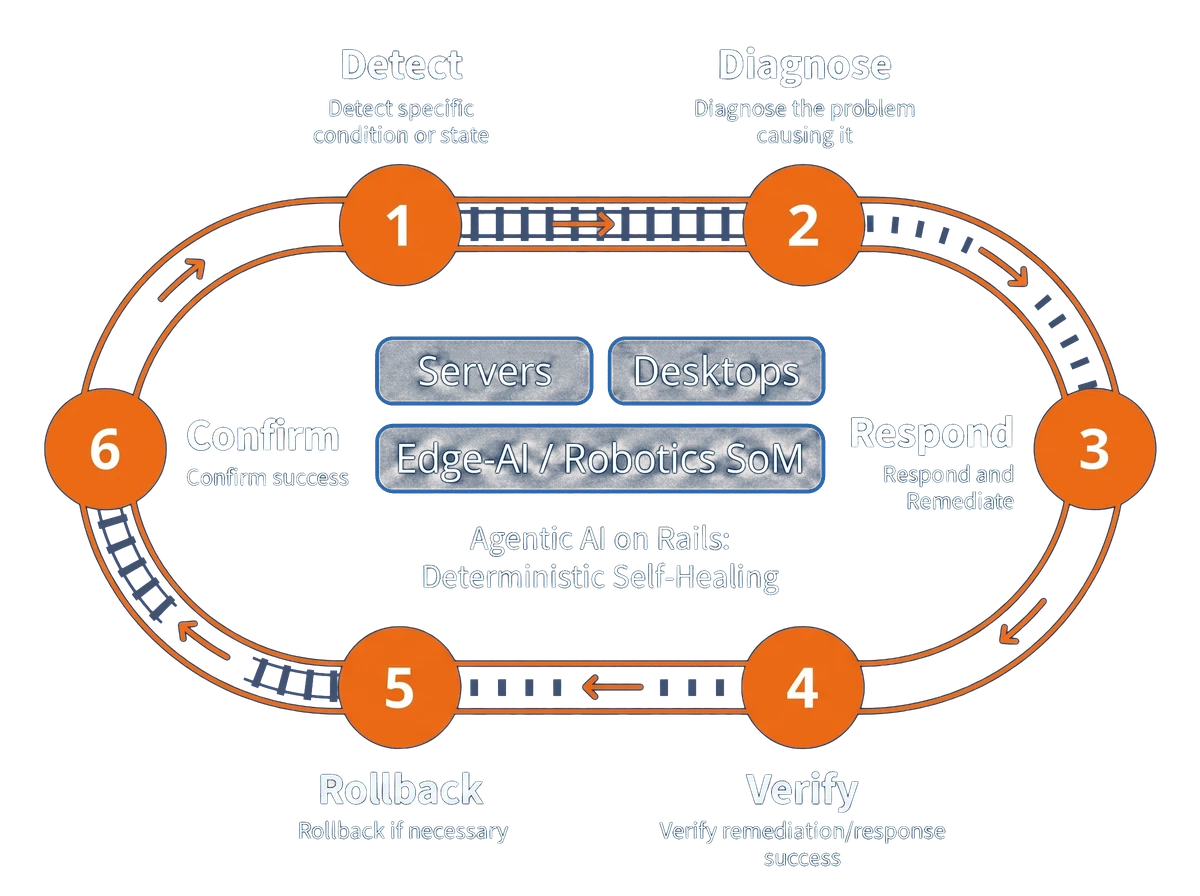
An Agentic RailBook is an executable guide for one problem or state change. It tells RailBook Runtime how to detect it, diagnose it, respond, verify the result and roll back. AI writes it. People approve it. The Runtime executes RailBooks autonomously, exactly as written.
Responds to problems
Remediation RailBooks
Something has failed or is failing. Find the cause, fix it, prove it's fixed.
Always On VPN fails — RasMan port already open
Responds to state changes
Conditional RailBooks
Nothing is broken, but something changed and a response is due.
Product changeover detected — load the matching model and recipe
Responds to threats
Security RailBooks
An attacker's technique appears. Detect it, contain it, remove it, record it.
Plugin: Edge AI — NVIDIA Jetson · Collection: Vision Inspection · Platform: Jetson Orin
1 · Detect
Rolling defect-detection confidence below the validated baseline for more than 60 seconds.
2 · Collect
Inference stats · camera pipeline · model registry · device health · line state
3 · Diagnose
Camera delivering frames? → Exposure within calibration? → GPU throttling? → Product SKU validated for this model? → Active model matches the approved model?
4 · Remediate
Restart vision pipeline — on its own Switch power mode — on its own Load SKU-matched model — on its own Roll back to last validated model — after the line supervisor approves
5 · Verify
Confidence back at baseline · frame rate restored · golden-sample images classified correctly
6 · Roll back
On failed verification: restore the previous settings and model, bring the line to its safe stop, alert the supervisor with the evidence.
An example RailBook, shortened. Every RailBook carries the same six parts.
RailBook watches the system's own signals — events, logs, telemetry, sensor readings, AI-model outputs — and recognizes problems and state changes as they happen.
2
Diagnose
It reasons across everything around the event to find the cause, not just the symptom.
3
Respond and remediate
It selects the matching RailBook and acts autonomously. Every step runs exactly as designed: same conditions, same response.
4
Verify
It confirms the result, and rolls back or brings in a person if it isn't right.
Where RailBooks come from
Write
Describe a problem or state change in plain language. RailBook Studio's AI writes the complete RailBook.
Check
Studio challenges its own draft and closes the gaps before anyone reviews it.
Approve
People review and approve every RailBook.
Deploy
Signed RailBooks go to RailBook Runtime on every platform.
Platforms
Runs where your systems run.
From data-center servers to edge-AI and robotics SoMs.
Windows
Desktops, laptops and servers
Endpoint and server problems, connectivity, security detection and response, application support.
macOS
Desktops and laptops
Application support, connectivity, security detection and response, configuration changes.
Linux servers
x86 and Arm
Services, containers and Kubernetes nodes, databases, storage, networking, security baselines.
NVIDIA Jetson
Edge AI
Vision and AI-inference pipelines, cameras, AI-model drift, thermal and power, robotics cells.
One way to Co-Author RailBooks. One way to run them. Every platform.
Domains
Where RailBook works.
Problems and state changes, detected and answered — in every one of these.
Agentic IT-Ops, on rails.
IT operations
Problems
Remote access that won't connect (VPN, ZTNA, VDI), Wi-Fi and network sign-in failures, crashing services, unhealthy nodes.
State changes
A certificate nearing expiry, a policy or configuration change, a device waking on a different network, a software update.
Example RailBooks
Always On VPN fails — RasMan port already open
Device certificate expires in 14 days — renew and verify
Wi-Fi 802.1X sign-in rejected after a policy change
Linux service crash-loops after a configuration change
Problems fixed on the device before anyone opens a ticket, and changes handled before they become problems.
Agentic Security, on rails.
Cybersecurity
Problems
Attacker techniques such as persistence, credential access and defense evasion.
State changes
A new scheduled task, service or administrator account; a firewall or logging policy changed outside change control.
Example RailBooks
Scheduled-task persistence (T1053.005)
Registry Run-key persistence (T1547.001)
New service installed for persistence (T1543.003)
LSASS memory access (T1003.001)
Event logging disabled (T1562.002)
Firewall policy changed outside change control
Detections and responses that run the same way every time and can be audited line by line — online or air-gapped.
Agentic Desktop Support, on rails.
Desktop and application support
Problems
Dropped calls, stalled sync, clients that can't reach their servers, sign-on loops, stuck print queues.
State changes
An app or driver update, a new peripheral, a profile moving to a new device.
Example RailBooks
Teams call audio drops — device conflict
OneDrive sync stuck — path too long
ERP client can't reach its server after reconnect
Clinical app single sign-on loop
Print queue stalled — spooler recovery
Driver updated — verify peripherals still work
App problems fixed where they happen, including the ones the app vendor can't reach.
Agentic Server Ops, on rails.
Server and cloud-native operations
Problems
Services in a crash loop, nodes that drop out, replication that falls behind, disks that fill.
State changes
A configuration or firewall change, a new deployment, a certificate rotation, a node joining or leaving.
Example RailBooks
Service crash-loops after a configuration change
Node NotReady — container runtime unresponsive
PostgreSQL replication lag over threshold
Disk 95% full — log rotation stalled
Firewall policy changed outside change control
Servers that recover autonomously, with every action recorded.
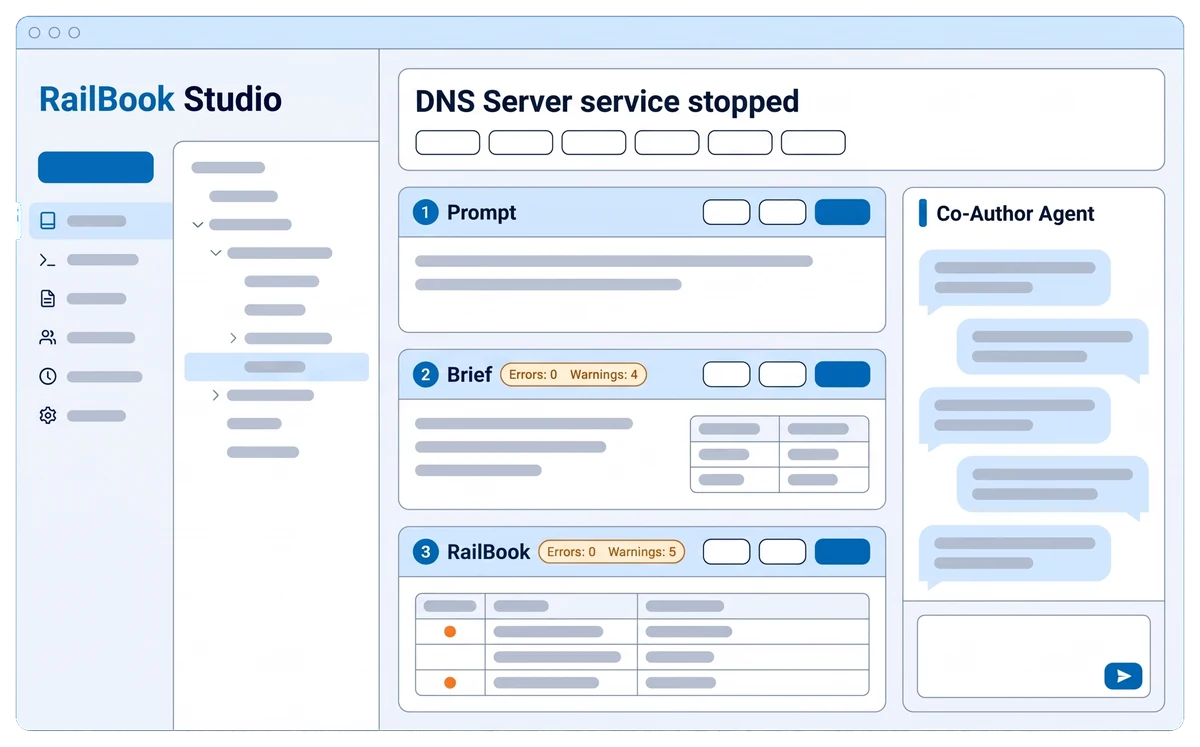
Prompt
A Detect and Remediate RailBook for a Windows Server domain controller where the DNS Server service (DNS) has terminated unexpectedly, detected via Service Control Manager events 7031/7034 in the System log, remediated by restarting the service, validated by confirming the service is running and listening on port 53, with escalation to a person if the restart fails.
Server operations on Windows Server. A failed DNS Server service on a domain controller — detected, restarted and verified. Simplified illustration of RailBook Studio.
Agentic Industrial Automation, on rails.
Industrial automation and edge AI
Factories, robots and edge-AI systems can't wait for a person or a cloud. RailBook gives them an autonomous, self-healing response layer that is deterministic, on the device, and works online or offline.
Problems
AI-model accuracy drift, stalled cameras, thermal throttling, sensor faults, field-bus errors, firmware that fails its integrity check, machine-health warnings.
State changes
A product changeover, a new model or recipe deployed, a controller configuration change, a tool swap, a shift or line-mode change.
Example RailBooks
Inspection-model confidence below baseline → roll back to the last validated model and verify accuracy
Product changeover detected → load the matching model and recipe; verify with golden samples
Camera stream stalls → restart the vision pipeline and re-verify the frame rate
Jetson thermal throttling → switch the power mode and rebalance the inference load
Sensor reading out of range → move the actuator to its safe state and alert the operator
Vibration signature drifts → reduce line speed and schedule maintenance
Controller configuration differs from the approved baseline → restore it and record the change
Firmware image fails its integrity check → recover from the golden image
CAN bus goes error-passive → isolate the faulty node and keep the line running
Production lines and edge-AI systems that detect, respond and recover autonomously. Every response is deterministic, approved and recorded, with no cloud required.
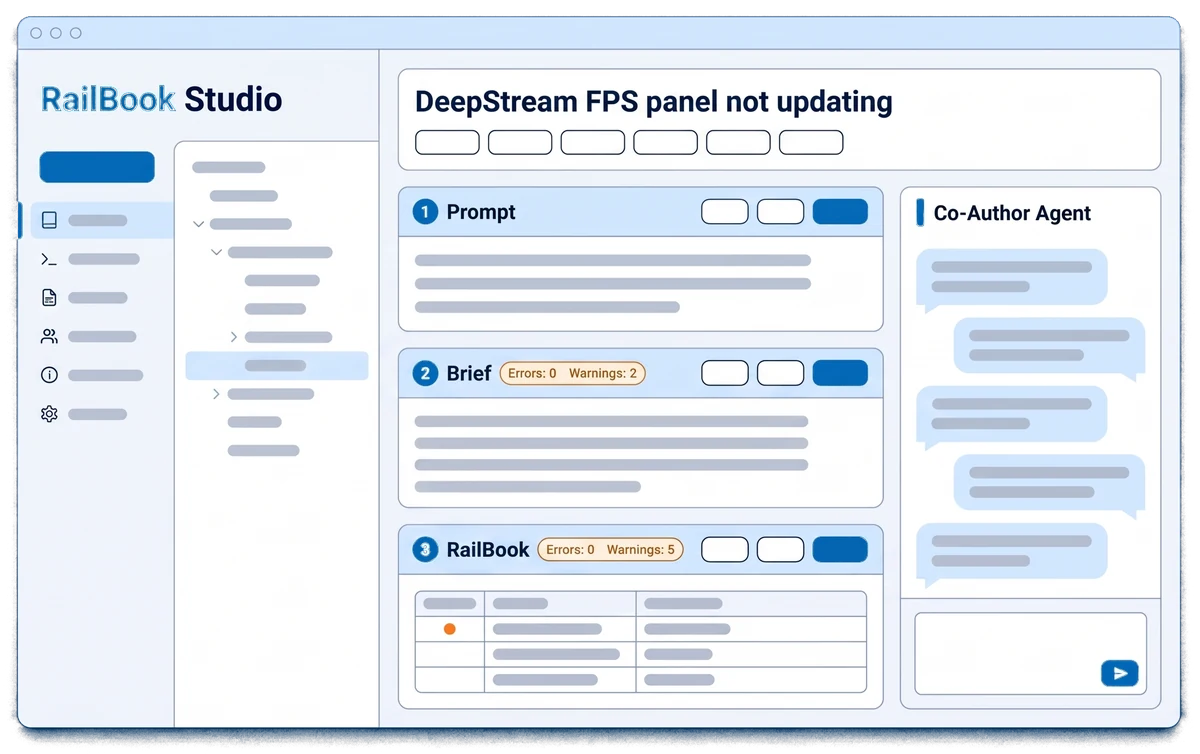
Prompt
A Detect and Remediate RailBook for an NVIDIA Jetson running DeepStream in the deepstream container, triggered when /data/logging-volume/deepstream.log stops growing (normally new lines about every 5 seconds) while the container is running; it escalates to a person if the logging volume is full, otherwise restarts the deepstream container and validates that the log is gaining new lines again.
Industrial automation on NVIDIA Jetson. A stalled DeepStream pipeline — from a prompt to a checked Brief and RailBook. Simplified illustration of RailBook Studio.
And many more.
Field operations
Robotics and autonomous systems
Healthcare and clinical devices
Financial trading desks
Retail and point of sale
Energy and utilities
Telecom and network edge
Transportation and fleet
Defense and air-gapped networks
Your own — state your intent, and the Co-Author writes RailBooks for your own systems
Co-Author Agentic RailBooks with AI. Approve them with confidence.
You don't write RailBooks. You state your intent in a sentence, and RailBook Studio's agentic Co-Author writes them — one at a time, or an entire Collection from a single prompt.
State your intent in a sentence or two. The agentic Co-Author asks for what it needs to know.
The Co-Author writes the complete RailBook: detection, diagnosis, response, verification and rollback.
It assesses and improves its own drafts before anyone reviews them.
Co-Author an entire Collection of RailBooks from a single prompt.
Review and approval sign-off on every RailBook.
Organize RailBooks into Collections and Plugins, and publish to shared Libraries.
Build and sign RailBook packs for every platform.
Use the AI models your policy allows: frontier cloud models or local models.
Collections
One prompt. An entire Collection.
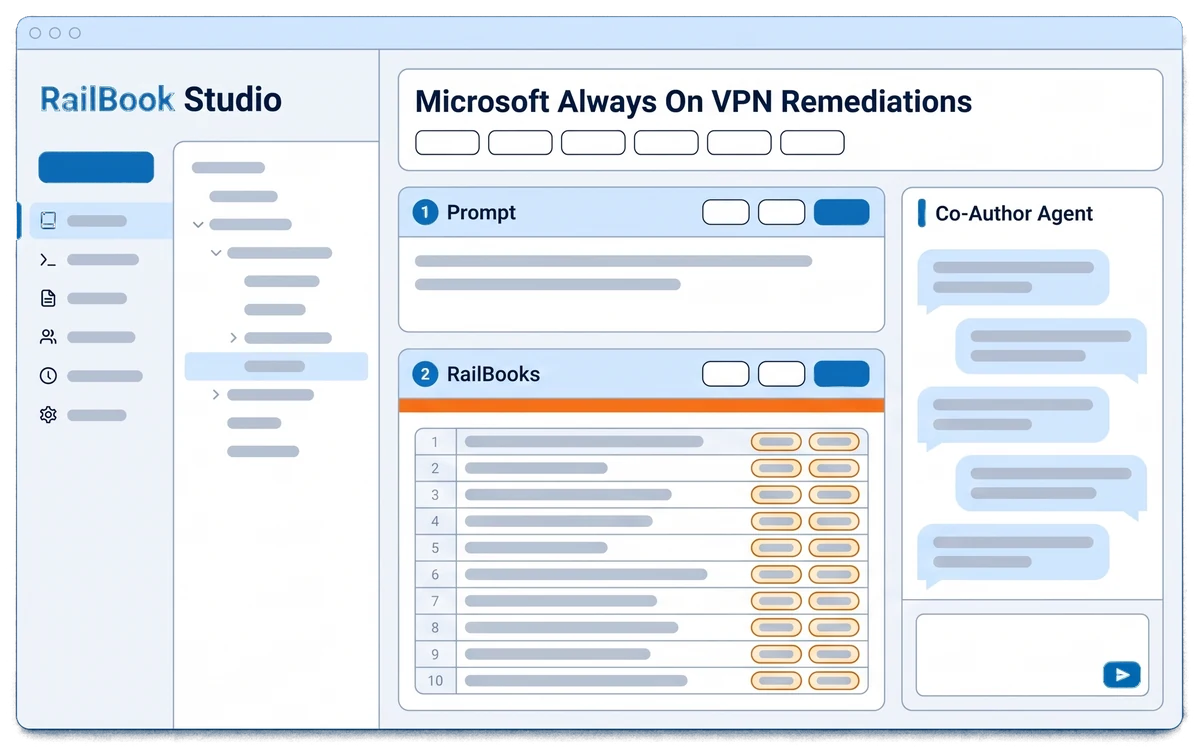
Co-Author a whole Collection of RailBooks from a single starting prompt. The Co-Author plans the Collection, then writes every RailBook in it — each one complete, each one checked, each one ready for your approval. Once approved, RailBook Runtime runs each one on the device: autonomous detection and deterministic remediation.
Your prompt
Create a Collection of RailBooks that autonomously detect and remediate common Microsoft Always On VPN issues on Windows 11 clients.
The Co-Author writes the RailBooks
Always On VPN IKEv2 connection fails with error 809 (no response from VPN server, UDP 500/4500 blocked)
Always On VPN IKEv2 connection fails with error 13801 (IKE authentication credentials are unacceptable)
Always On VPN user tunnel no longer auto-connects
Always On VPN device tunnel fails with error 13806 (IKE failed to find valid machine certificate)
Always On VPN user tunnel fails with error 798 (no certificate found for use with Extensible Authentication Protocol)
Always On VPN IKEv2 connection fails with error 13868 (policy match error)
Always On VPN SSTP connection fails with error 0x80092013 (certificate revocation server offline)
Always On VPN connected but internal DNS names do not resolve (NRPT rules or DNS suffix missing on client)
Always On VPN connected but on-premises resources prompt for credentials
Always On VPN cannot connect because Remote Access Connection Manager (RasMan) service is stopped
…and many more
Remote access on Windows 11. A whole Collection of RailBooks from one prompt. Simplified illustration of RailBook Studio.
RailBook Runtime™
Deterministic autonomy, on the device.
Detects problems and state changes from the device's own signals.
Responds autonomously, running the matching RailBook exactly as approved.
Verifies every result, and rolls back or hands off to a person when needed.
Uses on-device AI with no cloud required, so it works offline and air-gapped.
Runs everywhere from data-center servers to edge-AI and robotics SoMs.
Records every action in a tamper-evident audit log.
Connects to your SIEM, ITSM and automation platforms. Other AI agents can call RailBooks through MCP.
Receives updates as signed RailBook packs.
Built for trust
Deterministic autonomy. Safe to let it act.
Deterministic
Same conditions, same response, every time.
Human-approved
People approve every RailBook before it runs.
On-device AI
Intelligence runs on the device. Nothing has to leave it.
Works offline
Online, offline, or air-gapped: the same behavior.
Signed and audited
Signed RailBooks and a tamper-evident record of every action.
Fits your stack
SIEM, ITSM, MCP, and the device-management tools you already use.
Questions
What is an Agentic RailBook?
An Agentic RailBook is an executable guide for one problem or state change. It tells RailBook Runtime how to detect it, diagnose it, respond, verify the result and roll back. AI writes it. People approve it. The Runtime executes RailBooks autonomously, exactly as written.
Is RailBook autonomous?
Yes. RailBook Runtime detects, responds, verifies and rolls back without waiting for a person. Its response is deterministic: the same conditions always get the same approved response. Steps you mark as needing approval wait for it.
How is RailBook different from an AI agent?
An AI agent decides what to do at run time. RailBook uses AI to detect and diagnose, then autonomously runs a response that was written, checked and approved in advance, so the same conditions always get the same response.
How is it different from scripts and playbooks?
A script covers the one case its author thought of. A RailBook detects the event, diagnoses the cause among many, picks the matching response, verifies it and rolls back. AI writes it, so a catalog grows by description, not by hand.
Where does RailBook run?
On the device itself: Windows, macOS, Linux servers and NVIDIA Jetson, with no cloud required.
Who writes RailBooks?
RailBook Studio's agentic Co-Author does. You state your intent in plain language. The Co-Author writes the RailBook, or an entire Collection of them, and your people approve it.
RailBook.ai — Agentic AI, on rails.
Apply for the RailBook beta. Leave your email address and we will be in touch.
We use your email address only to contact you about the RailBook beta.